
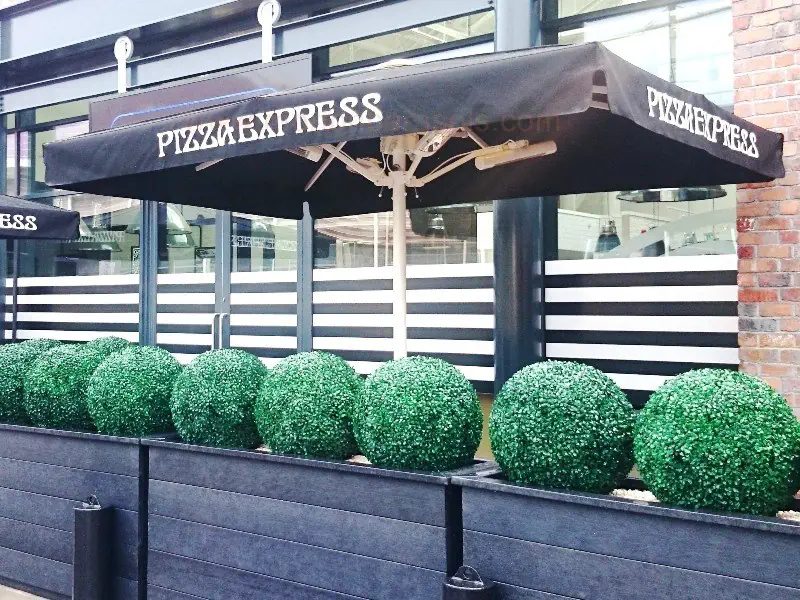
Commercial parasols range from a few hundred pounds for a smaller café model to more than £10,000 for a large structure with specialist features. Some exceptionally large models cost considerably more. The useful figure for your budget is the price of a parasol suited to your site, with its base, delivery and any installation included. A starting price rarely covers the whole project.
Current UK listings show smaller commercial and bistro parasols at around £300 to £700, while many larger, heavier models start above £2,000. Those figures describe different products and different price inclusions. They are a guide to the breadth of the market, not a promise of what a finished installation will cost.
Where does the money go?
Size is an obvious factor, but two parasols with similar canopy dimensions need not have similar prices. A canopy intended for occasional use over a couple of café tables has a different job from one opened and closed daily over a busy restaurant terrace.
A larger frame needs to support more fabric and remain practical for staff to operate. The mast, spokes, joints and opening mechanism all affect the price. Fabric choice matters too, particularly where a venue needs specific performance, appearance or branding. For a fair comparison, look beyond the dimensions and ask what each model is designed to do.
Shape also changes the value of the cover you buy. A rectangular canopy might fit a long row of tables more neatly than a round one of similar width. Its quoted area might look modest on paper, yet more of the shade falls where customers sit. Conversely, a large canopy offers little benefit if its mast or base blocks the route through your terrace.
Small commercial parasols
At the lower end, you will find compact centre-pole parasols suited to smaller seating areas and less complex layouts. UK listings include bistro models priced in the hundreds of pounds. Read the specification carefully: a low price tells you little about the base, fabric, operating mechanism or demands of frequent use.
As one example, Morton lists its Piazza self-opening parasol from £619, excluding VAT and delivery. Its published configuration options include different sizes and bases, which change the estimated price. The £619 figure is therefore a starting point for one model, not the cost of every Piazza parasol installation.
A smaller parasol makes sense when the area is compact, tables are easy to arrange around a central mast and staff have a suitable place to close or store the canopy. Buying several small parasols also gives a venue some flexibility. Staff can shade occupied tables without opening cover across the entire terrace.
That flexibility has a spatial cost. Several bases take up room, and gaps between canopies can leave diners exposed as the sun moves. If you are comparing several small units with one larger parasol, sketch both arrangements over your actual table plan.
Larger and heavy-duty models
Prices tend to rise when a venue needs a wider canopy, a stronger structure or more options for daily operation. A heavy-duty model might suit a hotel courtyard or restaurant terrace where one parasol covers several tables. The extra cost should serve a clear purpose, such as providing usable cover in the right position or meeting the demands of the site.
Morton lists its Schattello heavy-duty commercial parasol from £2,749, excluding VAT and delivery. Its live cost configurator shows separate charges for base choices and optional heating and lighting. It also shows how a change in canopy size affects the estimate. That makes the difference between a headline price and a specified parasol easy to see.
There is no fixed price boundary where a parasol becomes “heavy duty”. The description alone does not explain how a model will perform on your terrace. Compare its construction, permitted installation methods and operating requirements against the work you need it to do.
Very large structures sit at the upper end of the range. Their prices reflect a different scale of canopy, support and installation. For most venues, the relevant choice lies well below that end of the market. Work out the area you need to cover before treating the largest available model as the benchmark for your budget.
Centre pole or cantilever?
A centre-pole parasol places its mast beneath the canopy. It often fits naturally between tables or through the centre of a suitable table (small parasols up to 3m). Its position also needs checking against chairs, accessible routes and the path staff take while serving.
A cantilever parasol supports the canopy from the side. This frees the space immediately beneath it, which can help on a terrace where a central mast would disrupt seating. The base and supporting arm still need room. On a narrow site, moving the mast out of the dining area might place it in a walkway instead.
Do not assume one type costs less in every comparable size. Prices vary by model and specification. Start with a plan showing tables, doors, circulation space and the shade needed at the times your outdoor area gets used. You can then compare suitable centre-pole parasols and cantilever parasols against the same layout.
The base belongs in the budget
A parasol needs a fixing suited to its size and location. Depending on the model and site, options might include a weighted mobile base, a surface-mounted plate or an in-ground anchor. Each has a different effect on price and on how you use the space.
A mobile base preserves some flexibility, but you need room for it and a practical way to move the assembled unit. A permanent fixing keeps the position consistent, yet requires a suitable surface and the associated installation work. A fixing that looks discreet in a product photograph might be unsuitable for your paving, decking or ground conditions.
Check whether the advertised price includes a base. Morton’s Piazza and Schattello configurators, for example, show priced base options alongside their parasol starting prices. If one quotation includes a suitable fixing and another leaves it out, the two headline totals do not describe the same purchase.
How do optional features affect the price?
Lighting, heating, printing, side panels and linking gutters each answer a different need. None should appear in your budget merely because the option exists. Think about when people use the space and what prevents them from using it comfortably.
Lighting has a clear role on an evening terrace. Heating introduces equipment and electrical requirements as well as an ongoing running cost. Linking gutters address the gap between adjacent canopies, while side panels change how an area feels and functions. Branded and printed canopies affect appearance, but also adds a decision about artwork and placement.
These features deserve separate lines in a comparison. First price the parasol and fixing needed for shade. Then add the options that solve a specific problem at your venue. This approach shows the cost of each decision and prevents an appealing configured total from obscuring what the essential cover costs.
VAT, delivery and installation
Commercial parasol prices are displayed in different ways. One listing might include VAT and delivery. Another might exclude both. Some show a parasol price without a base, while others sell a package with a fixing and setup. Comparing the displayed numbers without checking those details produces a misleading range.
Ask for a written breakdown of the canopy and frame, base or anchor, delivery, VAT and installation where required. For powered options, establish what the parasol price includes and what work the site needs separately. The answer will depend on the product and the existing terrace, so an allowance borrowed from another venue offers limited help.
A starting price is useful for deciding which products merit a closer look. A configured estimate is more useful for budgeting. A final price should reflect the chosen specification and the work needed at your site.
What offers better value over time?
The cheapest unit has the lowest initial outlay. Whether it offers the lowest cost over its working life depends on how often you use it and what happens when parts wear or become damaged.
Ask about replacement canopies, available components and the maintenance the supplier recommends. Consider how staff will open, close and protect the parasol each day. A model that is awkward to operate might be left open when conditions call for closing it. A model that covers the wrong tables might provide little practical value despite a large canopy area.
You do not need the most expensive parasol to make a sound purchase. A modest café setup and an exposed hotel terrace place different demands on their equipment. Spend on the size, construction and fixing your location requires, then judge optional features on their own merits.
The price range for commercial parasols is broad because the term covers everything from compact table shade to substantial outdoor structures. For your own budget, begin with the area you need to cover and the conditions at that exact spot. Those details narrow a market-wide range into a useful comparison.