
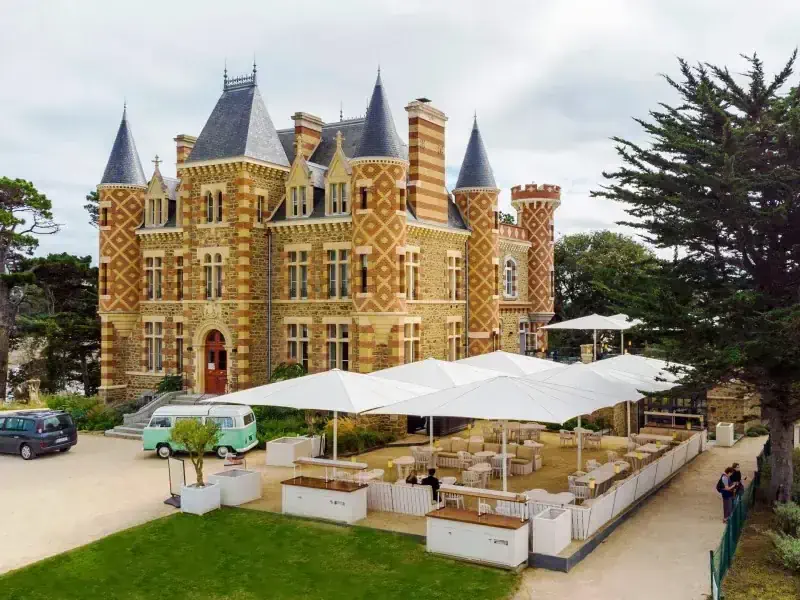
The sustainability of Schattello, Albatros and Typhoon parasols centres on keeping the products in service through durable construction, repairable components and replaceable canopies. European material sourcing, renewable electricity used in manufacturing and recyclable cardboard packaging also contribute. For commercial premises, the practical benefit is a parasol designed for maintenance and repair throughout its working life.
Assessing commercial parasol sustainability means looking beyond the materials listed in a brochure. Consider what happens when fabric wears, a component suffers damage or your terrace needs change. Retaining a sound frame and replacing individual parts gives you more options than replacing the complete parasol.
Why longevity matters for commercial parasol sustainability
Every new parasol requires raw materials, manufacturing, packaging and transport. Extending the useful life of an existing parasol reduces the need to repeat those activities through premature replacement. The environmental value comes from continued use, supported by appropriate maintenance and access to replacement parts.
Commercial settings place particular demands on outdoor equipment. Staff open and close parasols repeatedly, furniture moves beneath the canopy and exposed components face changing weather. Construction suited to these conditions helps prevent everyday use from becoming a reason for early disposal.
A long service life also depends on choosing a suitable specification. Canopy dimensions, wind exposure, opening clearance and fixing arrangements all influence how a parasol performs. A substantial frame still needs an appropriate installation and staff who understand its operating instructions.
Repairing individual components instead of replacing the whole parasol
The supplied sustainability specification for Schattello, Albatros and Typhoon describes frames and fabric designed for repair or replacement as required. This approach treats the parasol as an assembly of serviceable components. Damage to one part does not automatically require disposal of the remaining structure.
Consider a canopy damaged in one area while the frame remains sound. Assessing the fabric for repair or replacement preserves the opportunity to retain the mast and supporting structure. Similarly, an isolated frame fault deserves a component-level assessment before a complete replacement decision.
Repairability also requires accurate identification. Keep your model name, canopy dimensions, order information and fabric specification with your maintenance records. Photographs of the complete parasol and damaged area help establish which replacement component matches your installation.
Arrange structural repairs through an appropriate service provider. A repair needs to restore correct operation and structural integrity. Improvised changes introduce uncertainty about how the assembled parasol will perform.
How the three parasols support continued use
Schattello: maintaining fabric tension
The Schattello commercial parasol uses reinforced spokes held under continuous tension to keep its canopy taut. Morton identifies this arrangement as a feature supporting fabric longevity. Its aluminium structure and stainless-steel fittings provide a durable foundation for repeated commercial use.
For maintenance planning, assess the canopy and frame separately. Fabric condition and structural condition do not necessarily deteriorate at the same rate. Replacing worn fabric while retaining a serviceable frame puts the repairable design into practice.
Albatros: retaining a substantial terrace structure
The Albatros commercial parasol provides coverage for larger outdoor areas. Its reinforced spokes maintain canopy tension, while its telescopic closing system provides clearance above suitable furniture. These features support practical daily operation alongside long-term maintenance.
With a larger parasol, retaining sound structural components matters when fabric needs attention. Record the precise canopy shape and dimensions from the outset. This information supports replacement enquiries and helps avoid ordering an unsuitable membrane.
Typhoon: matching construction to the setting
The Typhoon parasol combines a substantial aluminium frame, reinforced spokes and stainless-steel fittings with an easy-clean PVC canopy. Its construction addresses demanding commercial applications, where material selection and maintenance requirements influence replacement decisions.
Consider the actual conditions at your premises. Confirm the operating limits for your exact size and fixing arrangement. Following those limits protects the structure and fabric from avoidable damage, supporting the longevity on which the sustainability approach depends.
European materials and what fabric certification means
The supplied sourcing information states the aluminium and fabrics come from European manufacturers. Those manufacturers operate under applicable requirements covering production, health, safety and employment. This provides useful supply-chain information for businesses reviewing purchasing standards.
Material origin alone does not establish a complete environmental assessment. Its value sits alongside product durability, manufacturing practices, repair support and end-of-life arrangements. Each answers a different question about how the parasol is produced and maintained.
The supplied fabric specification also identifies OEKO-TEX STANDARD 100 certification. This standard tests certified textile articles and their components against limits for harmful substances. Within the scope of the certified article, testing covers elements such as threads and accessories alongside the main textile.
For your purchasing records, retain the certification details relevant to your selected fabric. STANDARD 100 concerns harmful-substance testing. Separate evidence is needed for claims about recycled content, carbon emissions or the recyclability of a finished canopy.
Controlled welding supports consistent manufacturing quality
The manufacturer holds welding certification to DIN EN ISO 3834-3. This standard concerns quality requirements for fusion welding of metallic materials. Its relevance lies in the controls applied to welding processes, personnel and inspection.
For a commercial parasol, consistent welded joints support dependable construction. The manufacturer describes controls including welder certification, defined welding methods, testing and regular inspections. These provide a documented basis for assessing welding quality.
The connection with sustainability comes through manufacturing quality and the aim of prolonged service. Welding certification does not establish a specific lifespan or an environmental rating. Good production controls, suitable installation and ongoing care work together to support continued use.
Solar generation and purchased renewable electricity
The German manufacturer reports using rooftop solar panels to supply its operations. Its published information describes self-sufficiency when sunshine provides sufficient generation, with surplus electricity exported to the grid. Hydroelectric power supplies its operations when solar generation is insufficient.
This distinguishes electricity generated at the premises from electricity purchased from an external provider. Both form part of the manufacturer’s stated approach to its electricity supply. Renewable electricity addresses one element of production alongside materials, fabrication and transport.
For businesses assessing suppliers, the useful questions concern how energy is generated and which operations the information covers. Solar panels on a factory roof do not establish a carbon footprint for an individual parasol. A product-level calculation would require additional evidence across its life cycle.
Recyclable packaging and a protective cover with an ongoing purpose
The supplied packaging specification describes cardboard tubes and boxes, which are recyclable. Separate these materials during unpacking and place them in the appropriate cardboard collection. Keep the cardboard clean and dry before collection.
The protective sleeve or cover bag inside the tube has a continuing role. Retain this cover for protecting the closed parasol when out of use, following the instructions for your model. Include the cover in your equipment handover so staff recognise its purpose.
A missing cover loses this opportunity for continued use. Assign a storage location and explain when staff should fit the cover. Small operational details help ensure reusable items supplied with the product stay in service.
Separating materials at the end of service
The supplied design information describes disassembly without specialist tools, allowing components to be separated. Aluminium frames are suitable for recycling through an appropriate metal recycling route. Separation helps prevent recoverable metal from entering a mixed waste stream.
Fabric requires a different assessment. The manufacturer’s published disposal guidance distinguishes acrylic and polyester textiles from PVC fabric, with a separate take-back route described for its MayTex PVC. Availability and collection arrangements need confirmation before disposal from a UK site.
Ask your waste contractor about the precise materials involved. A dismantled parasol still needs suitable collection and processing. Keep electrical accessories separate and arrange appropriate handling for their components.
The strongest practical outcome starts before recycling becomes necessary. Keep service records, identify wear early and assess repair before replacement. For Schattello, Albatros and Typhoon parasols, longevity becomes meaningful through years of maintained use, supported by replacement components when individual parts reach the end of their service.