
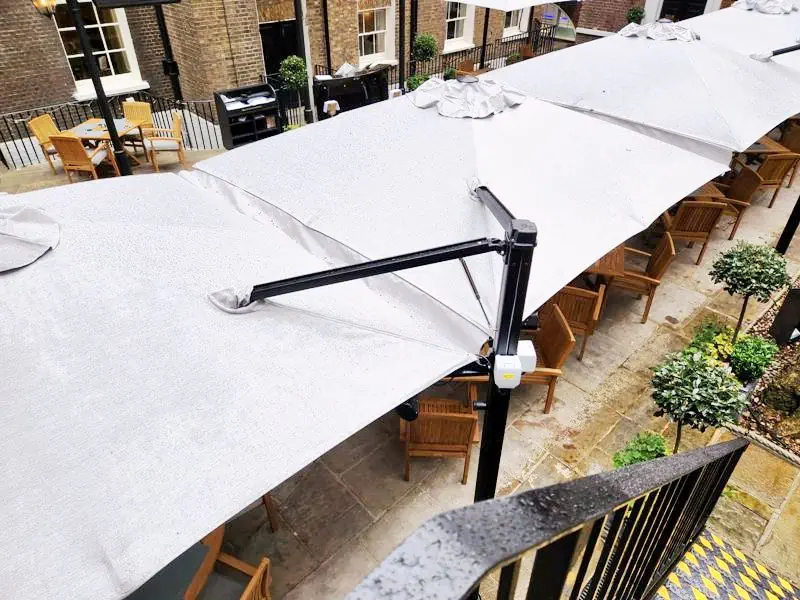
The best commercial patio umbrella is the one suited to your seating layout, wind exposure and preferred method of fixing. For most restaurant, pub and hotel patios, a well-anchored, heavy-duty centre-pole parasol is a sound starting point. Choose a cantilever parasol when a central mast would obstruct tables or movement. On an exposed site, give wind performance and the complete installation priority over canopy size.
“Best” depends on more than the strength of the frame. A parasol has to cover the seats people use, leave room for staff to work, open and close without disrupting service, and remain manageable throughout its working life. A large canopy with an awkward base or poor positioning rarely solves those problems.
What is the best commercial patio umbrella for your layout?
Start with a plan of the patio rather than a parasol catalogue. Mark the tables, chairs, walkways, doors and any areas where staff carry food and drinks. Then mark where a mast and base could stand without narrowing a route or taking the place of a seat.
A centre-pole parasol works well when its mast sits between tables or through a suitable table opening. The arrangement is straightforward, and several smaller parasols often suit a patio with separate seating groups. Staff can also shade one group while leaving another area open.
A cantilever parasol places the mast to one side of the canopy. This leaves more usable space directly beneath the shade, which helps when tables move for different group sizes or a central pole would interrupt service. This raises a practical question: where will the mast and its base go? A side-mounted canopy still needs a suitable fixing, and its support must fit the patio and the seating plan.
Morton’s centre-pole parasols and cantilever parasols show the difference between the two layouts. Compare the space beneath each canopy with the space required around its support. The better choice is the arrangement your team and guests can use comfortably.
Measure the shade where people sit
Canopy dimensions describe the fabric overhead. They do not tell you how much shade will fall on occupied chairs at every hour. Sunlight moves across a patio and a low afternoon sun reaches beneath the edge of a canopy. A drawing taken at lunchtime alone risks missing the period when your outdoor seats need shade most.
Look at the patio during its busiest hours. Note which seats receive direct sun, where shadows fall, and whether neighbouring buildings provide shade for part of the day. A square or rectangular canopy often follows a row of tables more closely than a round one. A round canopy could suit a freestanding seating group. Shape matters because shade falling beyond the patio edge does little for the people beneath.
Leave space for chairs to move and for people to stand without striking a mast or canopy edge. Check the opening height and the space occupied by the folded parasol, especially beside walls, doors and planting. A canopy which covers the right area when open still needs somewhere to go when staff close it.
Bigger is not always better. Two parasols placed around separate groups could give a small venue more shade control than one large canopy. A larger model becomes more useful where the seating arrangement stays consistent and a suitable fixing position serves the whole area.
How much does wind performance matter?
Wind deserves close attention on open terraces, waterfront sites and patios above ground level. Ask for the manufacturer’s wind information for the exact model and configuration under consideration. Check which canopy size, base or ground fixing the information covers. A figure attached to one configuration should not be assumed to apply to every size and installation.
For example, Morton lists its StrongWind parasol as wind-tunnel tested and certified up to 102 km/h. The figure is a product claim worth examining alongside the proposed fixing and the manufacturer’s operating instructions. A wind rating does not mean a parasol should stay open without supervision through changing weather.
The base is part of the decision, not an accessory to choose afterwards. Its specification needs to suit the parasol and the surface beneath it. A permanent ground fixing calls for a different assessment from a freestanding base on paving. On a raised deck, the supporting structure also matters. Do not assume a heavy-looking base provides adequate support for a large canopy.
Staff need clear instructions for closing and securing parasols when conditions change. Regular checks should cover the canopy, frame, fixing and moving parts. Guidance for commercial patio umbrellas recommends suitable anchoring, closing umbrellas when unused, and inspecting the complete assembly after wind events.
Choose fabric for the weather you expect
Decide whether the main job is shade, shelter from passing showers, or both. Fabric descriptions need careful reading. A “water-repellent” fabric is different to a claim of full waterproof protection and therefore calls for separate evidence. Even with a suitable canopy, wind-driven rain could reach people seated near the edge.
Ask how the fabric handles sunlight, cleaning and replacement. A patio beneath trees faces different cleaning demands from an open courtyard. Colour also changes the feel of the space. Light fabric gives a brighter area beneath the canopy, while darker fabric affects the shade and the look of the terrace. Request a fabric sample if the colour forms an important part of your venue’s visual design.
Examine the whole canopy rather than fabric alone. Seams, tension and the way the cover fits the frame affect how tidy the parasol looks after regular opening and closing. Confirm whether a replacement cover is available. Replacing worn fabric is a different expense from replacing an entire frame.
Think about a normal working day
A commercial parasol might be opened before service, closed when the weather turns, then secured at the end of the day. Try to understand each step before choosing a model. Who operates it? Where does the handle go? Will chairs or tables need moving? Could one member of staff close the canopy promptly?
Opening systems vary. Morton’s Schattello, for instance, uses a removable crank handle and a telescopic closing system designed to close above standard-height tables. Such a feature matters where staff would otherwise need to move furniture each time the parasol closes. The same question applies to any model: does its operation fit the way your patio works?
Consider storage as well. A closed parasol still occupies space and needs securing according to its instructions. A removable handle needs a place where staff will find it. If several people operate the terrace across different shifts, a simple closing routine has practical value.
Compare the complete cost
A starting price rarely describes the finished installation cost. Canopy size, fabric, base, fixing, delivery and optional equipment affect the final amount. Compare specifications on the same basis before deciding one model offers better value. If a price excludes VAT or delivery, include those amounts when assessing your budget.
Then look beyond the first purchase. Ask whether replacement covers and frame parts are available, and how the parasol will be maintained. A lower initial price might make sense for occasional use in a sheltered spot. A busy terrace could place greater value on straightforward operation and replaceable parts. Neither answer follows from price alone.
Heating and lighting also deserve a separate decision. They add complexity and cost. Choose them because your guests use the patio at times when the features help, rather than because the options appear on a product page. Shade during a summer lunch and comfort on a cool evening are different requirements.
So which type should you choose?
For a sheltered patio with tables arranged around fixed positions, begin by assessing centre-pole parasols. For flexible dining space where a mast would get in the way, assess a cantilever arrangement and its required fixing space. For an exposed location, examine documented wind performance, anchoring and staff procedures before comparing colours or optional extras.
The most useful test is to draw the proposed parasol in both positions: open during your busiest service and closed when the patio is still occupied. If the shade reaches the right seats, the support leaves routes clear, and staff can operate the parasol safely, you have a stronger answer than any claim of one universally “best” commercial patio umbrella.