
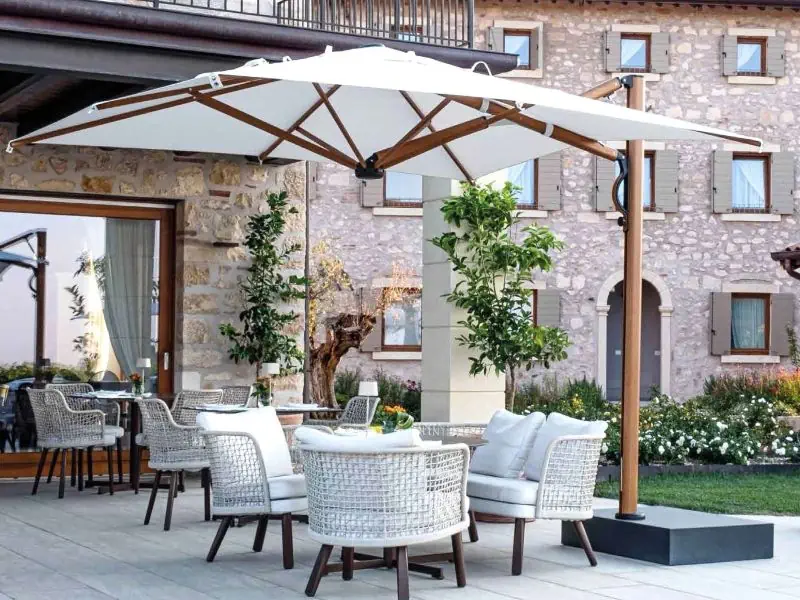
What to look for when buying a cantilever umbrella? Start with the space you want to shade, the position of the side mast and the fixing needed to keep the umbrella stable. Then compare how each model opens, moves and closes. Canopy size matters, but an umbrella only works well when its base, frame and operating space suit the site.
Start with the space beneath the canopy
A cantilever umbrella suspends its canopy from a mast at the side or above the canopy. This leaves the area beneath free from a central pole, which helps when you need shade over a dining table or seating space. The side mast still needs a suitable position. If the base sits in a walkway or the arm extends across a doorway, the clear space beneath the canopy offers little benefit.
Measure the furniture and the space people need around it. Allow room to pull out chairs, move between tables and open doors. Look at where the shade falls during the hours when the area gets used. A canopy centred over a table at midday might leave the people on one side in direct sun later in the afternoon.
Mark the proposed mast position on the ground before choosing a size. This gives you a clearer view of where the canopy will reach and whether the base will interfere with everyday use.
What to look for when buying a cantilever umbrella for a terrace
On a commercial terrace, the layout often matters more than the largest available canopy. A square canopy suits a defined seating group. A rectangular canopy might follow a long row of tables or a narrow dining area more closely. Round and octagonal canopies suit some open seating arrangements, though their curved edges leave different gaps when placed beside walls or neighbouring umbrellas.
Think about how the terrace changes during service. Staff need clear routes, and guests might move chairs beyond the table edge. Measure from the mast to the far edge of the shaded area, then check the position against the actual furniture layout. Catalogue dimensions describe the canopy. They do not tell you how much useful shade your particular layout will receive.
If you plan to cover several tables, compare one large umbrella with two smaller ones. Separate canopies give you more choice over which areas to shade, while a single canopy has fewer masts and bases to position. The better arrangement depends on the shape of the terrace and how you use each part of it.
Check the space needed to open and close the canopy
An umbrella needs clearance beyond its footprint when open. The canopy moves as you operate it, and some models extend or fold towards the mast when closed. Check the manufacturer’s dimensions for both positions, including the height of the closed canopy.
Look for nearby walls, signs, planting, lights and overhead structures. A canopy that fits neatly above a table while open might touch a wall as it closes. If the mast sits near a building, allow space to operate the mechanism without forcing the fabric or ribs against the wall.
Headroom matters too. Check the height beneath the canopy at its lowest edge, particularly where people will walk. If you want to tilt the umbrella, confirm how tilting changes that clearance.
Choose the base and fixing before ordering
The base forms part of the umbrella’s installation. Its size and weight need to match the specific model, canopy and site conditions. Do not assume a base supplied for a smaller umbrella will suit a larger one, or that a heavy-looking stand provides enough stability.
Freestanding weighted bases offer flexibility when an area changes layout, though their footprint takes up floor space. Do you require mobility to the extent that a wheeled base would be of benefit? An in-ground anchor keeps much of the fixing below the surface but requires groundworks. Other fixed mounting options depend on the structure beneath the finished surface. Decking, paving and concrete each need an appropriate fixing method.
For a permanent installation, check what lies beneath the terrace before choosing the umbrella. Surface paving alone does not establish whether a fixed anchor will work. For a freestanding installation, find out the required ballast for the exact umbrella and where the weighted base will sit. Leave room for people to walk around it without creating an obstruction.
Ask what a wind claim means
Descriptions such as “wind resistant” offer little guidance on their own. Ask for the operating guidance for the exact model and size. Check whether a stated wind performance depends on a particular base, fixing or canopy configuration. A larger canopy catches more wind, so do not assume every size in a range has identical requirements.
Consider the site as well as the umbrella. A sheltered courtyard and an exposed terrace present different conditions. Wind can also change direction or become turbulent around buildings. Staff should know when to close the umbrella and how to secure it once closed. A wind claim does not mean the canopy should stay open through severe weather.
Ease of closing the canopy matters in a busy setting. If the mechanism takes too much effort or several steps are easy to miss, staff might leave the umbrella open longer than intended. Try the controls if you have the opportunity, or ask for a demonstration.
Compare operation, rotation and tilt
Cantilever umbrellas use different opening systems. Depending on the model, you might find a crank, a sliding mechanism or assisted opening. Choose a system that the people using the umbrella can operate comfortably during a normal day, including when tables and chairs occupy the space beneath it.
Rotation helps when you want to move the shade as the sun changes position. Tilt alters the angle of the canopy, which is useful when sunlight comes from the side. These features have different purposes, and neither comes as standard on every model. Check which movements the particular version offers and whether you can lock it securely in the required position.
Movement also needs clearance. A rotating canopy might reach beyond its usual position into a neighbouring table, tree or building. Plan for its full range of movement, even if you expect to use only part of it most days.
Look closely at the frame and fabric
Inspect how the mast, arm and ribs connect. The quality of the joints, fittings and operating mechanism affects how the umbrella feels in daily use. Ask whether individual parts and replacement canopies are available. Replacing a worn component might be more practical than replacing the whole umbrella.
For the canopy, compare more than colour. Check the fabric specification for UV protection, water resistance and cleaning instructions. UV protection and rain performance answer different questions. A fabric might provide useful shade without keeping a seating area dry in prolonged rain. Stitching, seams and the canopy’s shape also affect how rain runs off.
Consider the colour in its setting. A light canopy changes the feel of the space beneath it, while a darker one gives a different appearance against the building and furniture. Ask for a fabric sample when colour is important. A photograph on a screen does not show precisely how the material will look on your terrace.
Decide whether extra features solve a real problem
Lights, heaters and linking gutters appear on some commercial umbrellas. Each adds a separate decision about installation, operation and maintenance. Lighting might help a terrace used after dark. A linking gutter might help where neighbouring canopies meet. Neither improves an umbrella placed in the wrong position.
If you want to add electrical features later, check compatibility before you buy. Accessories need suitable mounting points, and power needs a planned route. Also consider where staff will reach switches and controls. Keeping the initial specification simple often makes sense when the terrace sees limited evening use.
Compare the full installed cost
A headline price might cover the umbrella alone. The final cost can change with canopy size, frame finish, fabric choice and fixing method. A weighted base, protective cover, delivery and installation might appear separately. Check what the price includes before comparing two models.
For example, the Rimini cantilever parasol offers a choice of canopy configurations and bases. Its listed starting price changes as options are selected, and its product page states that carriage and VAT are excluded. This shows why the starting figure and the cost of a specified, installed umbrella need separate attention.
Ask about replacement fabric, spare parts and routine care as part of the comparison. An umbrella used daily on a hospitality terrace faces a different pattern of wear from one opened occasionally at home. The purchase price gives you only part of the cost over its working life.
Make the choice from a measured layout
Before ordering, record the area to shade, the mast position, the opening clearance and the proposed fixing. Then compare models against those measurements. Morton’s cantilever parasol range shows how much shapes, canopy arrangements and operating features vary within one type of umbrella.
The strongest choice is the one you can position, secure and operate properly in your space. A measured layout tells you more about that fit than canopy size alone.