
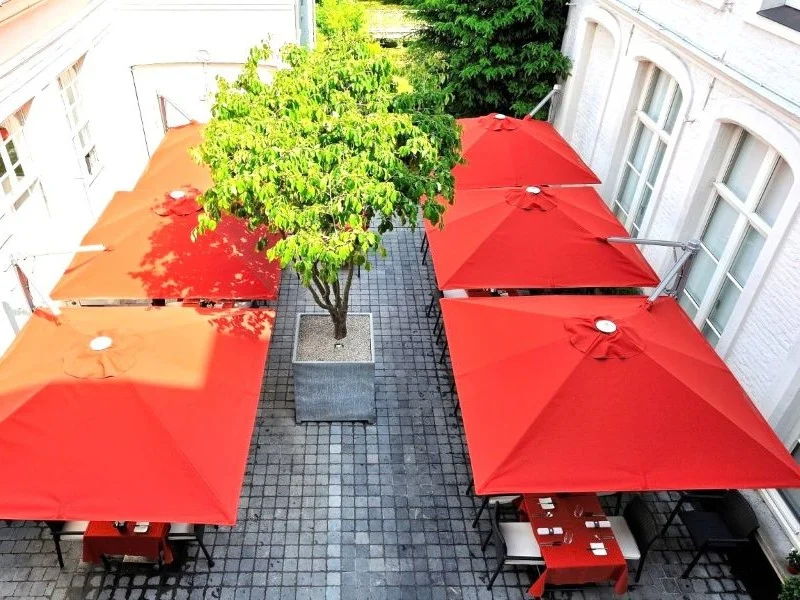
The best heavy-duty cantilever parasol depends on the space you need to cover and how you use it. For a commercial terrace, the Malaga suits layouts needing one, two or four canopies from a single mast. The Rimini works well where the area beneath the canopy must stay clear when the parasol closes. The Bordeaux offers more control over shade position through rotation and optional tilting. Each serves a different purpose, so canopy size alone should not decide your choice.
What are the best heavy-duty cantilever parasols in the UK for commercial spaces?
A cantilever parasol holds its canopy to one side of the mast. This leaves room beneath for tables, chairs or circulation. The advantage becomes clear on a busy terrace, where a central pole might dictate the seating arrangement. The trade-off is that the mast and its fixing must support a canopy extending away from them. A substantial frame needs an appropriate base or ground fixing, particularly in an exposed position.
Three models from Morton Commercial Parasols illustrate the main choices. They are examples of different layouts and operating features, not a ranking based on an unverified wind test. Compare the size and configuration you intend to use, then check its technical information and fixing requirements. A small single canopy and a large multi-canopy arrangement place different demands on their supports.
Malaga: for several seating areas around one mast
The Malaga cantilever parasol comes with an aluminium frame and stainless-steel fittings, and its gas-spring-assisted opening system helps staff raise and lower the canopy. When closed, the canopy retracts towards the mast, freeing the space previously beneath it.
The Malaga’s main advantage is its choice of single, double and quadruple configurations. A double canopy might cover two adjacent groups of tables. Four canopies around one mast might suit a broader seating area where several separate parasols would create too many obstacles. The canopies on a multi-canopy arrangement operate independently, so staff need not open every section at once.
That flexibility does not mean the largest version is the right answer for every terrace. A single canopy is simpler where you only need to cover one table group. For a narrow strip of seating, measure the full open canopy and its closing path before choosing a larger arrangement. The best position for the mast must also work with doors, walkways and service routes.
Rimini: for large tables and a clear space when closed
The Rimini cantilever parasol uses a gas spring to assist opening and closing. Its canopy moves back towards the mast as it closes. That feature is useful where staff rearrange furniture or need the covered area clear outside service hours. Morton lists single, double and quadruple versions, with square and rectangular canopy options.
A single Rimini also rotates through 360 degrees. Rotation helps when a fixed seating area needs shade at different times of day. Check the precise configuration before relying on this feature, as Morton specifies rotation for the single version. The site’s listed range extends from smaller commercial canopies to larger multi-canopy arrangements, so compare the dimensions of the actual version under consideration.
The Rimini is a strong candidate for a large dining table or a terrace where closing the canopy must not leave fabric hanging over furniture. Its practical advantage comes from the way it operates within the space, as much as from the area it covers.
Bordeaux: for shade that needs regular adjustment
The Bordeaux cantilever parasol rotates through 360 degrees and offers an optional tilting mechanism. Rotation changes the direction of the canopy around the mast. Tilting changes its angle. Together, those options are useful on a terrace where low afternoon sun reaches seats beyond the edge of a level canopy.
Before choosing tilt, consider who will adjust the parasol and how often. A fixed canopy position is adequate if the seating and sun exposure rarely change. Adjustable shade earns its place when it solves a recurring problem, such as glare across outdoor dining tables later in the day. The Bordeaux is available in square, rectangular and octagonal shapes, giving you ways to match the canopy to the footprint of the seating.
Rotation also needs physical clearance. Check nearby walls, planting, lights and other parasols across the full arc you expect to use. A rotating canopy offers little benefit if obstacles restrict it to one position.
Start with the area people use, not the advertised canopy size
Measure the tables and seats while people are using them. Include the space needed to pull out chairs and move between tables. A canopy whose dimensions match the tabletop might leave customers sitting beyond its shade. Equally, a larger parasol might extend over a walkway or neighbouring space you do not intend to cover.
Canopy shape matters. A rectangular canopy often follows a row of tables or a long terrace more closely than an octagonal one. A square canopy suits a compact group of furniture. With any shape, look at where the shade falls during the hours when the space is busiest. The shaded area moves as the sun changes position, even though the canopy stays in the same place.
Make a scaled sketch of the open canopy, mast and furniture before settling on a size. Mark entrances, emergency routes, planting and overhead fittings. Then check the parasol’s position when closed. These two views often reveal problems a photograph of an open parasol will miss.
How much does the fixing matter?
The fixing is central to the choice of a heavy-duty cantilever parasol. An offset canopy places a different load on its support from a centre-pole model. A substantial mast does not compensate for an unsuitable base, weak substrate or poorly positioned anchor.
Available fixing options vary by model. The Malaga page, for example, lists pedestal, in-ground, deck-plate and wall-anchor options. Those choices do not make every surface suitable for every installation. A paved terrace, timber deck and concrete slab each need a fixing assessed for the specific parasol and location. A wall-mounted option also needs a suitable supporting wall.
A movable pedestal offers flexibility when the terrace layout changes, but it occupies floor space. An in-ground anchor gives the mast a fixed location and leaves less visible hardware at ground level. Neither choice is automatically better. Decide whether you need to move the shade before planning furniture around a permanent mast.
Does “heavy-duty” mean the parasol stays open in strong wind?
No. “Heavy-duty” describes a type of construction, not permission to leave a parasol open in all weather. Wind performance depends on the particular canopy size, frame, fixing and conditions at the site. A sheltered courtyard and an exposed rooftop present different demands. Do not treat a general description of a model as a wind rating for every configuration.
If wind exposure is a concern, ask for the technical data for the exact size and fixing you intend to use. Establish clear instructions for staff on when to close it. Regular operation matters on a commercial site: a parasol only provides useful shelter if staff know how to open, secure and close it correctly.
Canopy vents and robust materials deserve consideration, but neither removes the need for suitable anchoring and sensible use. Check the manufacturer’s operating guidance rather than relying on the appearance or weight of the frame.
What else should you compare before choosing?
Daily handling deserves as much attention as the initial specification. Try to establish how the canopy opens, where it sits when closed and whether one member of staff can operate the chosen configuration as intended. On a restaurant terrace, those details affect the routine at the start and end of every service.
Look at the fabric and the availability of replacement parts. A commercial canopy will spend long periods outdoors, so the ability to replace a damaged component matters over its working life. Ask how to clean and store the fabric, and check whether a protective cover fits the chosen arrangement. If you want heating or lighting, confirm compatibility with the particular model and canopy configuration before planning electrical work.
Finally, compare the complete installed specification. Canopy size, fabric choice, base or anchor, optional equipment, delivery and installation all affect the final cost. A starting price describes an entry configuration, not the finished cost of a large terrace installation.
Which one is the best fit?
Choose the Malaga when several canopy sections from one mast solve a layout problem. Consider the Rimini when easy operation and a clear area after closing matter most. Look at the Bordeaux when adjusting shade direction and angle would improve how people use the space. Morton’s cantilever parasol range also includes other shapes and arrangements if these three do not fit your terrace.
The best choice is the one whose open canopy covers the seats you intend to use, whose closed position leaves the space workable, and whose fixing suits the site. Get those three decisions right before adding optional features.